The Book · Written by Gil Roman
Read the story behind the film.
Choose your format. Same story. Same descent.
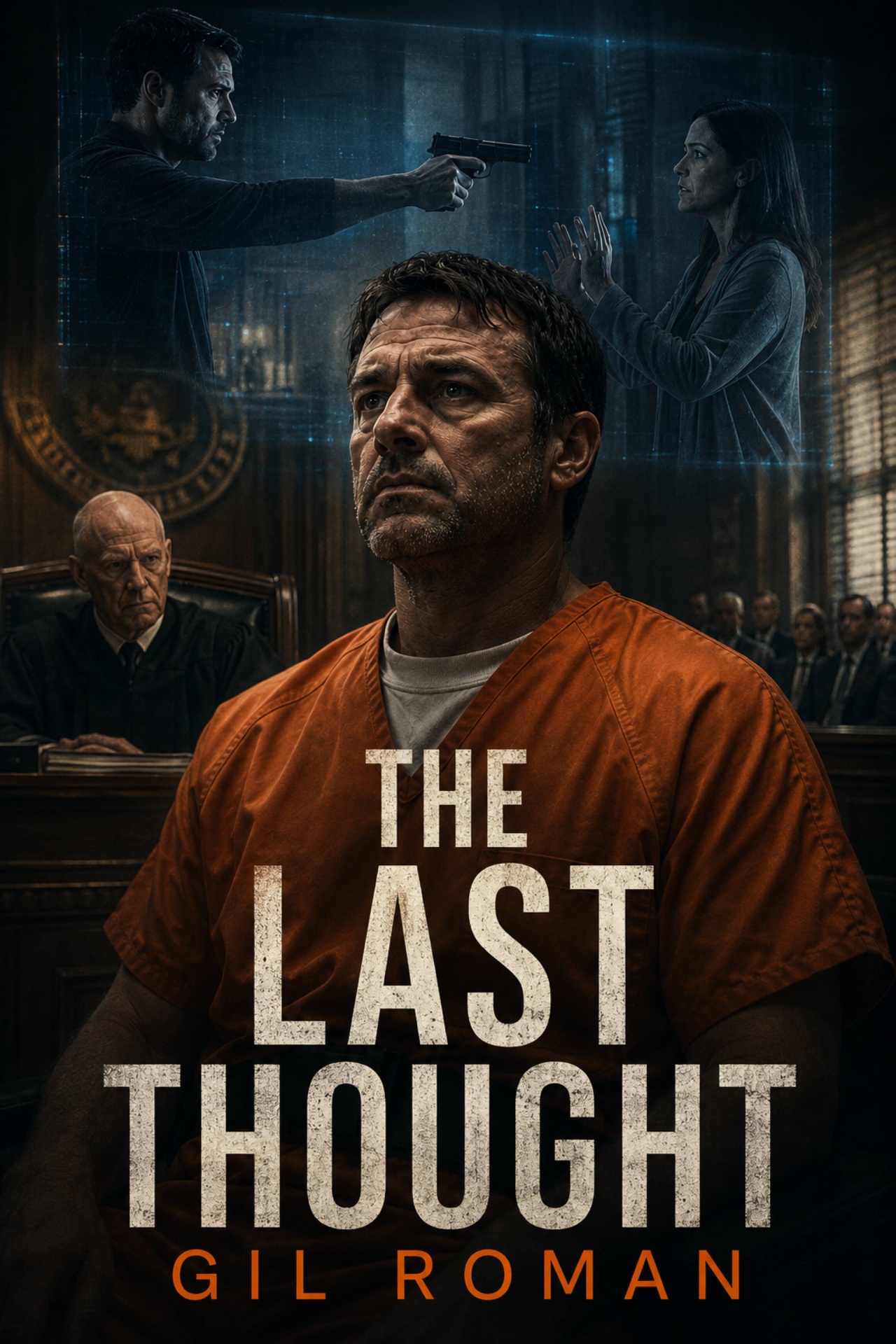
Paperback
$9.99
Year 2047. The Neural Evidence Act has made brain-reading technology — MemScan — legally admissible in all courts worldwide. Every arrest now ends in a mandatory scan. Memories are evidence. Thoughts are testimony. Privacy is a relic. Detective Kael Renn believed in the system. Until the day a scan came back blank — and he realized the truth had been edited before it ever reached him.
Kindle eBook
$1.99
Year 2047. The Neural Evidence Act has made brain-reading technology — MemScan — legally admissible in all courts worldwide. Every arrest now ends in a mandatory scan. Memories are evidence. Thoughts are testimony. Privacy is a relic. Detective Kael Renn believed in the system. Until the day a scan came back blank — and he realized the truth had been edited before it ever reached him.
Prologue
The Ordinary Day
The rain starts a little after seven, and Sarah Hale decides not to mind it.
She stands at the kitchen window with the coffee going and watches the water come down the glass in long ropes, the yard beyond it gone soft and gray, the swing set blurred to a suggestion of itself. Saturday rain. The best kind. The kind that cancels nothing because nothing was planned, that asks nothing of you except that you stay home and be a family inside a warm house, which is the only thing she wanted to do anyway.
Behind her, the house is making its morning sounds. The furnace ticking. The seventh stair complaining under a small foot, then the eighth, then the small avalanche of the last three taken in a jump that has been forbidden at least two hundred times. Lily lands in the kitchen doorway in her dinosaur pajamas with her hair standing off her head like a struck match.
“It's raining,” Lily says, in the tone of a person delivering breaking news.
“I heard a rumor.”
“Can we make the pancakes? The real ones. Not the sad ones.”
The sad ones. One time — one time — Sarah had made pancakes from a mix that promised fluffy and delivered apologetic, and her daughter has carried the grievance for two years the way other people carry mortgages.
“Get the bowl,” Sarah says, and Lily is already dragging the chair across the floor to climb to the cabinet, and Sarah lets her, even though the chair-dragging wakes the whole house, because waking the whole house is, this morning, the point.
Marcus comes down eleven minutes later in the t-shirt with the faded logo of a company that no longer exists, his hair doing the thing it does, and he stops in the doorway and looks at the two of them — flour on the counter, flour on the floor, flour somehow on the window — and says, “There was a flour event.”
“There was no event,” Sarah says.
“Daddy, we're making the real ones.”
“I can see that. I can see most of them on your mother.”
He crosses the kitchen and kisses Sarah on the temple, on the exact spot he has kissed her every morning for eleven years, the spot she privately thinks of as his, and steals coffee from her cup with the other hand because he believes after all this time she doesn't notice. She notices. She has always noticed. It is, possibly, her favorite of his crimes.
They argue, while the first pancakes ruin themselves the way first pancakes do, about nothing. About whether the music should be his playlist or hers. About whether the word is syrup or syrup, pronounced two ways she could not spell differently but which they have litigated since their third date. About whether Lily's school project — a diorama of the water cycle, due Monday, started never — constitutes an emergency.
“It's not an emergency,” Marcus says. “It's a shoebox with cotton balls in it.”
“It's thirty percent of her grade.”
“She's nine. Her grade is in crayon.”
“Daddy.”
“I'm just saying the stakes are manageable.”
It is nothing. It is the kind of argument you would not even remember having by dinner, the kind made of love wearing its work clothes, and Sarah stands in the middle of it with the spatula in her hand and the rain on the window and her people in her kitchen, and something in her chest pulls tight and strange — a feeling she gets sometimes lately, more than she used to, like a hand closing gently around everything she has. Like she is looking at the morning from somewhere else. From far away. From after.
She shakes it off.
The pancakes come out right — the real ones — and Lily eats four and wears the syrup home-team proud on her chin, and Marcus does the dishes badly, and at some point in the gray middle of the morning all three of them end up on the couch under one blanket meant for one person, watching the rain, and Lily falls asleep between them with the suddenness of a dropped phone.
On the shelf across the room, among the photographs, sits the snow globe.
It is a cheap thing. A souvenir from a boardwalk, a tiny crooked lighthouse inside it, the glitter long since gone clumpy. Lily had been two when Marcus won it at some rigged game, two and a half when she'd first shaken it and watched the white flecks swirl down and pronounced, with the gravity of a scientist naming a law of the universe: rain in a jar. The name stuck the way names do in a family. The globe has survived three moves, one dropped box, and an entire childhood. Sarah looks at it for a long moment over her daughter's sleeping head.
Remember this, she thinks. Not the big days. The wedding got photographed; the hospital the night Lily came got photographed; the big days take care of themselves. Remember this one. The flour. The argument about syrup. The weight of the girl asleep on your arm and the man pretending he isn't asleep too, and the rain coming down on a house where, for one whole ordinary Saturday, nothing is wrong and nothing is owed and everyone you love is under one roof and breathing.
Remember it exactly.
Remember it as if someone, someday, might try to take it from you.
The rain goes on. The house holds. The morning, like all mornings, ends — but slowly, and gently, and not yet.
Not yet.
By Episode
Episode Films
Five chapters. One unraveling truth.
- 0115s preview
Episode 1 — The Denial
Marcus Hale takes the stand and tells his own lawyer, under oath, that he does not remember shooting his wife.
- 0215s preview
Episode 2 — The Playback
The court plays his memory back to him. Marcus watches himself pull the trigger and breaks — because he still doesn't remember it.
- 0315s preview
Episode 3 — The Wrong Hand
Sentenced to prison, Marcus remembers he's left-handed. The memory on the screen fired with the right. It's impossible.
- 0415s preview
Episode 4 — Six Years Earlier
A flashback to the lab where Marcus first built the technology that would one day convict him.
- 0515s preview
Episode 5 — The Interview
The morning after the breakthrough. Marcus sits for the interview that will introduce his invention to the world.
Membership
Stream every episode.
$9.99/month
Stream every episode of The Last Thought, with exclusive behind-the-scenes scans, director commentary, and early chapter previews from Gil Roman.